How to Tell When Your Tires Are Actually Done
Tread depth, sidewall numbers and wear patterns explained plainly, so you know before you're stranded whether it's time for new tires.
September 14, 2026 · 3 min read
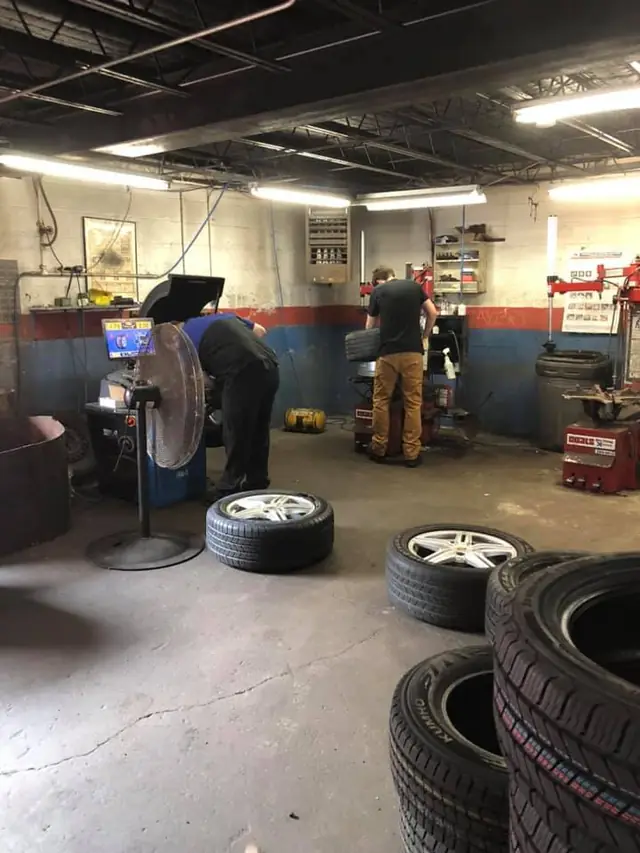
A customer once told us her tires 'still had rubber on them' the same week we pulled a nail out of one that had almost nothing left in the groove. Tread does not wear out evenly, and it rarely announces itself, so here is how to actually tell when a tire is done instead of guessing.
The penny test, and why it is not the whole story
Turn a penny upside down and push it into the tread groove with Lincoln's head pointing down. If you can see all of his head, the tread is worn down near the commonly used legal minimum of 2/32 of an inch, and the tire needs attention. It is a fine quick check in a parking lot, but it only tells you about the one spot you tested. Tread wears unevenly across a tire and across the four tires on a car, which is why we measure at several points on each tire rather than trusting one poke with a penny.
What the numbers on the sidewall actually mean
The string of letters and numbers on the sidewall, something like P215/65R16 98H, is not decoration. The first number is the tire's width in millimeters, the number after the slash is the sidewall height as a percentage of that width, and the number after the R is the wheel diameter in inches. The number and letter at the end are the load index and speed rating, how much weight the tire is built to carry and how fast it is rated to go while carrying it. There is also a date code stamped into the sidewall, four digits, the first two are the week of the year and the last two are the year the tire was made. A tire can have plenty of tread left and still be old enough that the rubber has started to dry out.
Reading wear patterns like a diagnosis
How a tire wears tells you what is actually going on with the car, not just the tire.
- Wear across the center of the tread usually means the tire has been overinflated
- Wear along both outer edges usually means it has been underinflated
- Wear on just one edge, one side of the car, usually points to an alignment issue
- Cupping or scalloping, a wavy pattern around the tread, usually points to a suspension component that needs attention
- Feathering, where the tread blocks are smooth on one edge and sharp on the other, is a classic alignment sign
When it is time to replace, not patch
A puncture in the main tread can usually be patched properly. A puncture near the shoulder or in the sidewall itself cannot, the sidewall flexes too much for a patch to hold safely. Every tire also has built-in wear bars, small raised sections inside the tread grooves, and once the tread is worn flush with those bars, it is done regardless of how the rest of the tire looks. Cracking in the sidewall rubber, sometimes called dry rot, is another one to watch: a tire can fail from age even with tread left on it, especially if it sits outside through Rhode Island winters. A tire that has been patched more than once, or patched too close to a previous repair, is also a replace rather than a patch, since the rubber around the old repair has already been weakened.
What we check when you bring one in
When you bring tires in, we mount them, balance the assembly, and check pressure and torque before the car leaves the bay. Most installations are finished the same day. We stock Goodyear, Michelin, Bridgestone, Continental, Pirelli, Yokohama, Falken, Kumho and General, across passenger, all season, high performance, light truck, mud, off road, run flat and snow tires, so most cars leave with the right tire in stock rather than waiting on an order. If you are not sure whether a tire needs replacing or just needs air, bring it by and we will measure it properly rather than have you guess with a penny in a parking lot.
Anything we install carries our nationwide warranty, up to 24 months, and if you have a lower price from somewhere else, bring it in and we will match it or beat it, some restrictions apply. Call (401) 394-3041 or stop by 580 Pawtucket Ave and we will take a look before you have to find out the hard way.
BTS Tire & Service Store, (401) 394-3041
Call (401) 394-3041More articles
What's Actually in Our Free Seasonal Vehicle Check
Before you ask for the free seasonal check, here is exactly what we look at and why each item made the list.
What Rhode Island's Safety Inspection Actually Checks
As inspection station 774, we see the same handful of items fail more than anything else, here is what the test actually covers.